
Most peptides sold online come with a mechanism, a few mouse studies, and nothing else. Thymosin alpha-1 breaks that pattern. It is the active ingredient in an approved drug, sold in dozens of countries, tested in large human trials as recently as last year. So the question worth asking isn’t “does this peptide sound impressive.” It’s narrower: what do the actual trials say, disease by disease, and does the answer change depending on how big and how careful the trial was? It does, and that pattern is the most useful thing a reader can take from the evidence.
What is thymosin alpha-1?
A 28-amino-acid peptide, made naturally by the thymus gland, the organ where young immune cells learn to become working T cells. The synthetic, medical-grade version is called thymalfasin, sold under the brand name Zadaxin. A 2020 review in the World Journal of Virology puts it plainly: thymalfasin is approved in more than 35 countries, mainly for chronic viral hepatitis and as a support drug in cancer care, with a side-effect profile that mostly stops at injection-site irritation (World Journal of Virology, 2020) [1].
What it is not matters just as much. Not a stimulant. Not a steroid. Not growth hormone. It doesn’t build muscle or torch fat or sharpen focus. It’s an immune modulator, a specific and narrow job description, and the evidence lines up with that job description and nothing more.
How does it work?
The same review traces three mechanisms. It acts as a Toll-like receptor agonist at TLR2 and TLR9 on dendritic cells, the immune system’s dispatchers. It helps immature thymocytes finish developing into working CD4+ and CD8+ T cells. It can switch on natural killer cells directly (World Journal of Virology, 2020).
Put simply, it pushes a sluggish or scattered immune response back toward order. Useful when immune defenses are depleted, which is why it’s been tested in chronic infection and in cancer patients. Also the exact reason a clinician would pause before prescribing it to someone on immunosuppressants, a point this piece comes back to.
Does it actually work? Line up the trials by size
Here’s the organizing fact: run the three disease areas in order of trial size, and the effect gets smaller as the trial gets bigger and better designed. That pattern alone tells a reader more than any single percentage.
Hepatitis B, 98 patients, strong positive. A 1998 randomized controlled trial in Hepatology gave 98 chronic hepatitis B patients either a 26-week course of thymosin alpha-1, a 52-week course, or no treatment. At 18 months, complete virological response, meaning both HBV DNA and HBeAg cleared, hit 40.6% in the 26-week group versus 9.4% in untreated controls (P = .004) (Hepatology, 1998) [2]. A 2008 meta-analysis in Antiviral Research pooled four trials, 199 patients, and found the benefit built gradually after treatment ended rather than showing up immediately (Antiviral Research, 2008). This is the evidence behind the drug’s hepatitis approvals abroad, and it holds up.
Sepsis, 361 then 1,089 patients, positive shrinks to nothing. The 2013 ETASS trial, 361 patients with severe sepsis, reported 28-day mortality of 26.0% on thymosin alpha-1 versus 35.0% in controls. Promising, except the relative risk was 0.74 with a confidence interval of 0.54 to 1.02, meaning it missed statistical significance (Critical Care, 2013) [3]. Twelve years later, the question got a real answer. The 2025 TESTS trial in the BMJ, double-blind, placebo-controlled, phase 3, analyzed 1,089 patients: 28-day mortality of 23.4% on the drug versus 24.1% on placebo, a hazard ratio of 0.99. The authors’ own conclusion: no clear evidence thymosin alpha-1 lowers sepsis mortality (BMJ, 2025) [4]. Bigger, better trial, smaller effect, then no effect at all.
COVID-19, 103 patients then 771, dramatic shrinks to nothing. A 2020 retrospective cohort in International Immunopharmacology reported 28-day mortality of 12.7% on the drug versus 60.4% without it, among 103 critically ill patients, a hazard ratio of 0.11 (International Immunopharmacology, 2020) [5]. That figure gets quoted constantly. What gets left out: a 2021 multicenter retrospective study of 771 patients, properly matched for baseline differences, found 51.0% mortality on the drug versus 52.9% without it, no significant difference, no association with survival (International Immunopharmacology, 2021) [6]. Same shrinking pattern, just compressed into one year instead of twelve.
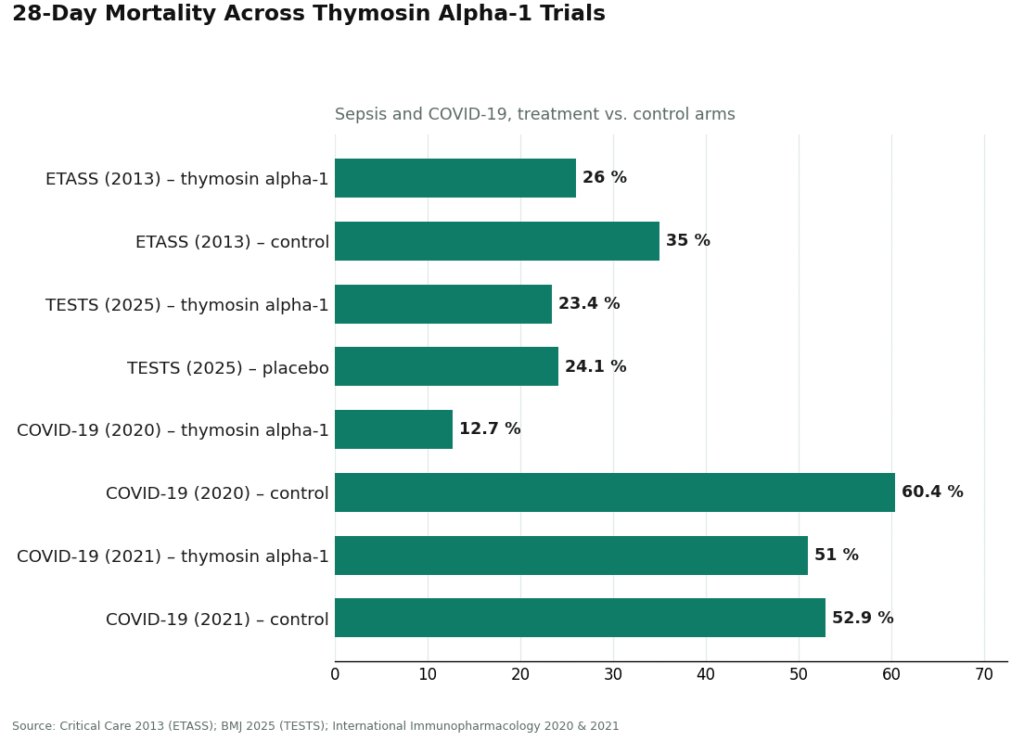
Three diseases, one repeating shape: small trial, big number; large trial, number collapses. Hepatitis B is the outlier, its bigger meta-analysis still confirmed the effect. Sepsis and COVID did not survive the upgrade to bigger, better-controlled studies.
How is it dosed?
As a subcutaneous injection. Beyond that, there’s no single number, because the regimens in the literature are tied to whatever condition was studied, not to a universal protocol. The hepatitis B trials used a fixed multi-week course, not an open-ended one (Hepatology, 1998). A separate dosage explainer in this series covers the research-supported ranges in more depth. The short version: this is dosed like a prescription immune drug, matched to a patient and a purpose, not read off a vendor label.
What’s the one safety flag that matters?
Tolerability, across decades of approved use, is genuinely good. The 2020 review lists local injection-site irritation as the main complaint, with occasional fever, fatigue, or muscle aches (World Journal of Virology, 2020). Neither the sepsis nor the hepatitis trials turned up serious drug-related safety problems. Safe is not the same as effective, and the sepsis data above is the reminder of why that distinction matters.
The one real interaction follows straight from the mechanism. Because the drug switches on immune activity, it’s generally avoided in people whose immune systems are deliberately suppressed, organ-transplant patients on tacrolimus or cyclosporine, for instance. Revving up immunity works against the entire point of those drugs. It’s the kind of conflict a clinician catches during an intake review and a checkout page cannot catch at all.
How do people actually get it in the US?
Zadaxin is approved and sold abroad, but it has never cleared FDA marketing approval here. So in the US, it exists only as a compounded medication: licensed pharmacy, prescription, physician oversight.
That’s why the route matters as much as the molecule. A supervised path, such as the licensed telehealth provider FormBlends, puts a clinician in the loop: history reviewed, immunosuppressant interaction screened for, prescription written only when appropriate, medication compounded and dispensed by a licensed pharmacy. That single example illustrates the supervised category, not a product to buy here. The alternative, a vial labeled “for research use only” from a chemical retailer, skips every one of those checks and substitutes a disclaimer instead.
The short version
Thymosin alpha-1 has something almost nothing else in this category has: an actual clinical file. Strong for chronic hepatitis B. Negative for sepsis, once the largest and best-designed trial weighed in. Split for COVID-19, with the larger, better-matched study finding nothing. Safety record: good. Interaction to watch: immunosuppressants. Legal status in the US: compounded, not FDA-approved. Whoever holds all five of those facts at once knows more than either side of the market wants them to know. None of this is medical advice; that decision sits with a licensed clinician.
What people tend to ask
Is thymosin alpha-1 FDA approved? No. It’s approved in more than 35 countries as thymalfasin (Zadaxin), for chronic viral hepatitis and as a cancer-care adjunct, but never in the US [1]. Here it’s available only as a compounded medication through a licensed pharmacy, prescription required.
Does it work for hepatitis B? Yes, and the evidence is solid. A randomized trial found 40.6% complete virological response with a 26-week course versus 9.4% in untreated controls (P = .004) [2], and a later meta-analysis of four trials confirmed the benefit built over time.
Does it help with sepsis or COVID-19? The best evidence says no. The 2025 TESTS trial, over 1,000 patients, found 23.4% mortality on the drug versus 24.1% on placebo, no benefit [4]. COVID-19 evidence is split: an early, small, retrospective study showed a dramatic survival edge [5], but a larger, properly matched study of 771 patients found no association with survival once baseline differences were accounted for [6].
Is it safe? Generally, yes. Side effects across decades of approved use mostly stop at injection-site irritation, with occasional fever or fatigue [1]. Neither of the large sepsis or hepatitis trials found serious drug-related harm. Safety, though, says nothing about effectiveness, which is a separate question with a separate, mixed answer.
Who should avoid it? People on immunosuppressant therapy, organ-transplant recipients on drugs like tacrolimus or cyclosporine especially, since an immune-activating peptide works against the point of those medications. That’s exactly the kind of conflict a clinician screening is built to catch.
How is it taken? As a subcutaneous injection, dosed according to whatever condition is being treated rather than one fixed protocol. The hepatitis B trials, for instance, used a set multi-week course, not an ongoing one [2]. A qualified clinician sets the dose; it isn’t a number you copy off a label.
References
- Costantini C, Bellet MM, Pariano M, et al. A reappraisal of thymosin alpha1 in cancer therapy. World Journal of Virology. 2020.
- Chien RN, Liaw YF, Chen TC, et al. Efficacy of thymosin alpha1 in patients with chronic hepatitis B: a randomized, controlled trial. Hepatology. 1998;27(5):1383-1387.
- Wu J, Zhou L, Liu J, et al. The efficacy of thymosin alpha 1 for severe sepsis (ETASS): a multicenter, single-blind, randomized and controlled trial. Critical Care. 2013;17(1):R8.
- Liu D, Yu W, Yan Y, et al. Efficacy and safety of thymosin alpha 1 for sepsis (TESTS): multicentre, double blinded, randomised, placebo controlled, phase 3 trial. BMJ. 2025;388:e082583.
- Liu Y, Pan Y, Hu Z, et al. Thymosin alpha 1 reduces the mortality of severe coronavirus disease 2019 by restoration of lymphocytopenia and reversion of exhausted T cells. International Immunopharmacology. 2020;88:106869.
- Sun Q, Xie J, Zheng R, et al. The effect of thymosin alpha1 on mortality of critical COVID-19 patients: a multicenter retrospective study. International Immunopharmacology. 2021;90:107143.